Moving machinery
Reduce trailing signal cable exposure while retaining local sensor wiring.
WLC-NODE / RETROFIT TELEMETRY
Keep the existing strain-gauge load cell. Review a battery-powered wireless bridge node and matched receiver for the signal chain you already have.
Configure & pair receivers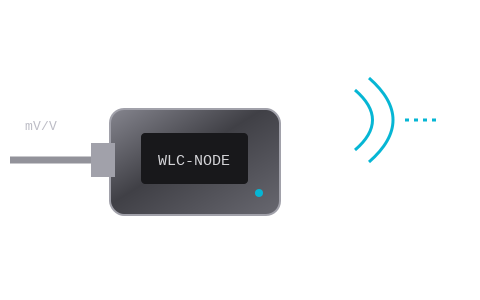
Family selection scope. Individual capacity, IP rating, RF range, proof load, battery life and approvals require a model-specific quotation.
BEFORE YOU FREEZE THE SPECIFICATION
Send bridge resistance, full-scale mV/V, excitation limits and the wiring diagram. Six-wire sense connections need an explicit termination strategy. Amplified 4–20mA or 0–10V sensors require the corresponding input module; they cannot be connected to a bridge input by changing the plug.
Reduce trailing signal cable exposure while retaining local sensor wiring.
For slow rotating fixtures, declare RPM and mounting radius. Review centrifugal loads, balance, battery retention and antenna shadowing.
Retain the mechanical sensor installation and recalibrate the full electrical chain.
Many full-bridge strain-gauge cells can be adapted after electrical and environmental review. Piezoelectric, digital and conditioned-output sensors need suitable electronics; universal plug-and-play compatibility is not assumed.
High-rate sampling, buffering and over-the-air reporting are different tasks. Required points, latency, RF bandwidth, duty cycle and battery life must be evaluated together. A 500Hz sampling request is not a promise of continuous 500Hz LoRa transmission.
CONFIGURE / PAIR / REQUEST
Build a measurement chain for review. We will confirm the sensor rating, RF path and compatible receiving hardware in the quotation.
[email protected]Send drawings by email. No immediate price or radio approval is implied by this selector.